
Are Peptides Steroids? Peptides vs. Steroids Explained
Peptides and steroids are often mentioned in the same conversations about muscle growth, recovery, hormones, body composition, and athletic performance. That overlap has created a common question:
Are peptides steroids?
No. Peptides are not steroids.
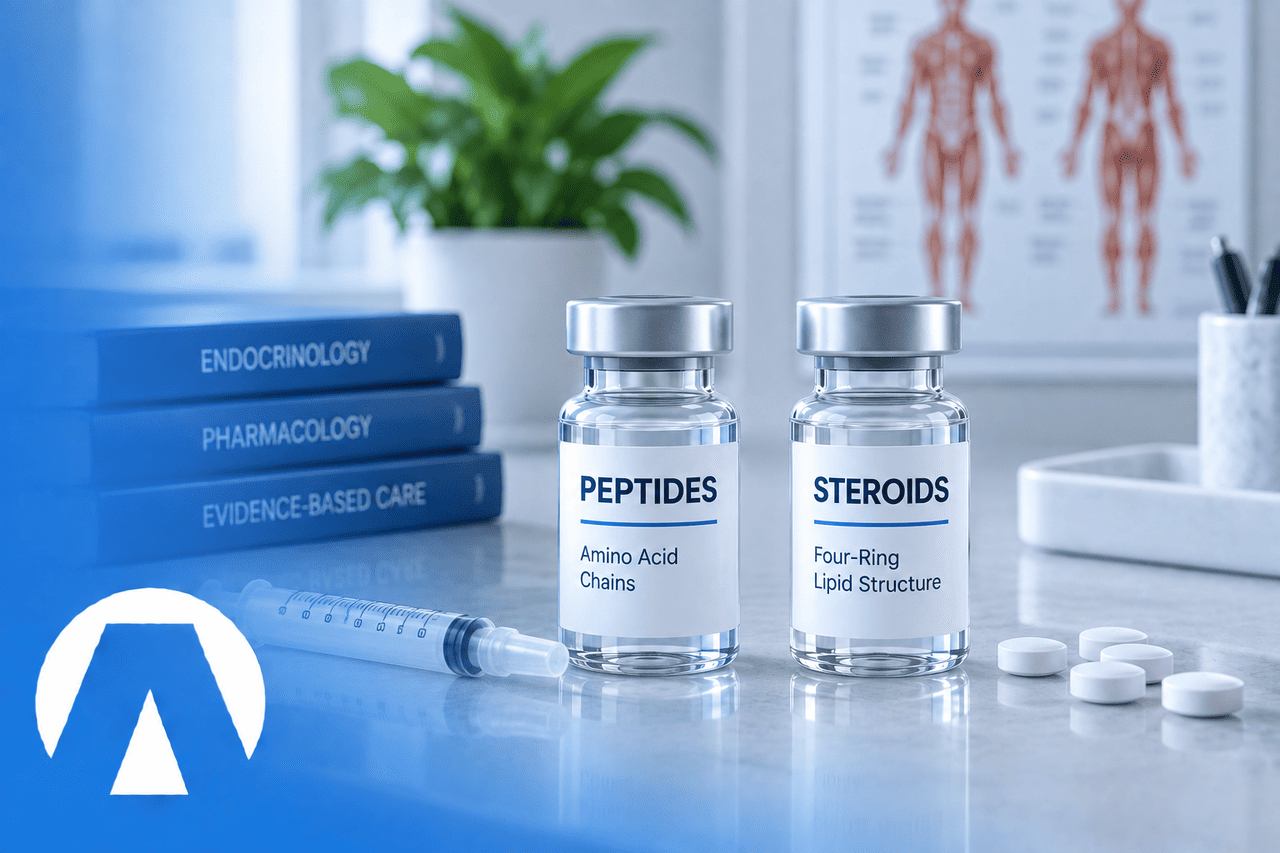
Peptides are molecules made from chains of amino acids. Steroids are a chemically different class of molecules characterized by a four-ring carbon structure. Steroid hormones such as testosterone and cortisol are therefore fundamentally different from peptide hormones and peptide-based medications.
The confusion is understandable. Certain peptides can influence hormone signaling, growth hormone pathways, metabolism, recovery, or body composition. Steroids can influence some of those same outcomes through completely different biological mechanisms.
That does not make peptides and steroids interchangeable.
It also does not mean that peptides are automatically safer than steroids. The word "peptide" describes a broad molecular category. Some peptides are naturally produced by the human body. Some are established medications. Others are investigational compounds with limited human safety data. The FDA has specifically identified potential safety concerns with several peptides promoted in compounding and wellness settings.
Understanding these differences is particularly important for anyone considering peptide therapy, hormone therapy, or performance-related products.
This guide explains peptides vs. steroids, why they are often confused, whether peptides can build muscle like steroids, how they affect hormones, whether peptides are safer, and why the specific compound matters far more than the label "peptide."
Quick answer: Peptides are not steroids. Peptides are chains of amino acids, while steroids have a characteristic four-ring chemical structure. Some peptides and steroids can affect overlapping processes such as hormone signaling, muscle growth, metabolism, or recovery, but they work differently and have different risks. Being a peptide does not automatically mean a compound is safer, FDA-approved, or appropriate for medical use.
What Are Peptides?
Peptides are chains of amino acids connected by chemical bonds called peptide bonds.
Amino acids are often described as the building blocks of proteins.
When amino acids connect together, they can form peptides and, as chains become larger and structurally more complex, proteins.
The human body naturally produces an enormous variety of peptides. They participate in biological processes ranging from hormone signaling to immune function.
Some naturally occurring peptide or protein hormones include signaling molecules involved in:
appetite
glucose regulation
reproduction
growth
stress responses
fluid balance
metabolism
Medicine has also developed numerous peptide-based therapies.
This is why discussing "peptides" as though they represent one drug is misleading.
A peptide may be:
naturally produced in the human body
a pharmaceutical medication
an analogue of a natural hormone
a compounded preparation
an experimental research compound
a product sold online without established quality or clinical evidence
Those categories can have dramatically different levels of evidence and risk.
Are Peptides Steroids?
No. Peptides are not steroids.
The two categories differ in their chemical structures and biological properties.
Peptides consist of amino acids linked together.
Steroids have a characteristic carbon structure consisting of four fused rings.
This means that calling a peptide a "steroid" is chemically inaccurate.
However, confusion occurs because some peptides and steroids can affect overlapping biological systems.
For example, depending on the specific compound, both categories can potentially influence:
muscle tissue
body composition
hormone signaling
recovery
metabolism
exercise performance
Reaching a similar physiological endpoint does not make two compounds chemically identical.
A simple analogy is that acetaminophen and ibuprofen can both reduce pain, but that does not make them the same type of medication.
Similarly, a peptide and a steroid may both affect body composition while operating through very different pathways.
Are Peptides Considered Steroids?
No.
Peptides are not considered steroids simply because they influence hormones or muscle growth.
This distinction is particularly important because the term "steroid" is frequently used loosely.
In everyday fitness conversations, people often use "steroids" to mean anabolic-androgenic steroids used to increase muscle mass or athletic performance.
Scientifically, however, steroids represent a much broader molecular class.
Steroid hormones naturally produced by the body include:
testosterone
estradiol
progesterone
cortisol
aldosterone
Peptide hormones belong to a different biochemical category.
Therefore:
Testosterone is a steroid hormone.
A peptide hormone is not a steroid hormone.
Are Steroids Peptides?
No.
The reverse is also false.
Steroids are not peptides.
Peptides are constructed from amino acids.
Steroids are built around their characteristic fused-ring structure and are generally derived biologically from cholesterol.
The molecules therefore differ substantially in:
chemical structure
synthesis
transport
receptor interactions
metabolism
cellular signaling
Some steroid and peptide hormones can ultimately influence overlapping physiological functions, but they reach those effects through different mechanisms.
Are Peptides the Same as Steroids?
No.
Peptides and steroids differ at the most basic chemical level.
The easiest comparison is:
Peptides = amino-acid chains
Steroids = lipid-derived four-ring molecules
That structural difference affects how they behave in the body.
Steroid hormones are generally lipid-soluble. This allows many steroid hormones to pass through cell membranes and bind to intracellular receptors.
Many peptide hormones instead interact with receptors located on cell surfaces, initiating signaling cascades inside the cell.
There are nuances and exceptions in biology, but this general distinction helps explain why peptides and steroid hormones should not be treated as interchangeable substances.
What Are Steroids?
The word steroid describes a family of molecules sharing a characteristic chemical structure.
The human body naturally makes steroid hormones.
Examples include:
Testosterone
Testosterone is an androgen and steroid hormone involved in sexual development, reproductive function, bone health, muscle tissue, red blood cell production, and other physiological processes.
Estradiol
Estradiol is an estrogen steroid hormone important in reproductive physiology, bone health, cardiovascular physiology, and many other functions in both women and men.
Progesterone
Progesterone is a steroid hormone with important reproductive functions.
Cortisol
Cortisol is a glucocorticoid steroid hormone involved in stress responses, metabolism, inflammation, and immune regulation.
Aldosterone
Aldosterone is a mineralocorticoid steroid hormone involved in sodium, potassium, fluid balance, and blood pressure.
The word "steroid" therefore does not inherently mean an illegal bodybuilding drug.
Your body produces steroids every day.
What Are Anabolic Steroids?
Anabolic-androgenic steroids, or AAS, are compounds related to testosterone.
The term "anabolic" refers broadly to tissue-building effects, while "androgenic" refers to effects associated with male sexual characteristics and androgen signaling.
Some anabolic steroids have legitimate medical uses.
The major safety problems discussed in sports and bodybuilding often involve nonmedical anabolic steroid use, particularly supraphysiologic doses, combinations of multiple compounds, or prolonged unsupervised exposure.
Potential adverse effects can involve:
natural testosterone production
fertility
cholesterol
blood pressure
red blood cell production
cardiovascular health
liver health with certain compounds
acne
hair loss
mood and behavior
gynecomastia
reproductive function
The risk varies according to the specific drug, dose, route, duration, patient, and other substances being used.
Is Testosterone a Steroid?
Yes.
Testosterone is a naturally occurring steroid hormone.
This sometimes creates confusion around testosterone replacement therapy, or TRT.
Medically supervised TRT for appropriately diagnosed testosterone deficiency should not automatically be equated with nonmedical anabolic steroid abuse.
They may involve molecules from the same pharmacologic family, but the indication, dosing strategy, monitoring, treatment goals, and exposures can be substantially different.
For legitimate TRT, the goal is generally to treat appropriately diagnosed testosterone deficiency based on symptoms, laboratory evaluation, clinical context, and provider assessment.
The goal is not to produce unlimited or supraphysiologic testosterone levels for bodybuilding.
Affinity Whole Health provides testosterone replacement therapy for appropriately evaluated men when there is a clinical indication for treatment.
What Are Peptide Hormones?
Some hormones are peptides or proteins rather than steroids.
Peptide hormones use amino-acid-based structures to carry biological signals.
Examples include several hormones involved in:
growth
appetite
metabolism
reproductive signaling
glucose regulation
fluid balance
One major distinction involves how peptide and steroid hormones interact with cells.
Many peptide hormones cannot freely diffuse through cell membranes. Instead, they bind to receptors on the cell surface and trigger intracellular signaling.
Steroid hormones are generally lipid-soluble and can cross cell membranes, where they interact with intracellular receptors that can influence gene transcription.
This is an important biological difference between peptide hormones and steroid hormones.
Peptides vs. Steroids: What's the Difference?
The biggest differences involve molecular structure and mechanism.
Peptides are made from amino acids
Peptides consist of amino acids connected by peptide bonds.
Steroids have a four-ring structure
Steroid hormones share a characteristic fused-carbon-ring framework.
They can signal differently
Many peptides bind to receptors on cell membranes.
Many steroid hormones cross cell membranes and interact with intracellular receptors.
Their effects depend on the specific compound
There is no universal "peptide effect."
Likewise, there is no single "steroid effect."
The biological outcome depends on which molecule is being discussed.
Their risks differ
A peptide affecting appetite has a different safety profile from a peptide influencing growth hormone signaling.
Testosterone has a different risk profile from corticosteroids.
Therefore, statements such as "peptides are safer than steroids" are usually too broad to be medically useful.
Why Do People Think Peptides Are Steroids?
The confusion largely comes from bodybuilding and performance-enhancement culture.
Certain peptides have been marketed or discussed for goals such as:
increasing muscle mass
improving recovery
reducing body fat
stimulating growth hormone
improving athletic performance
accelerating injury recovery
Those goals overlap with reasons some people misuse anabolic steroids.
As a result, peptides and steroids often appear in the same:
bodybuilding forums
social media videos
performance-enhancement discussions
supplement websites
anti-doping policies
But being discussed together does not make them chemically identical.
WADA's prohibited-substance framework demonstrates this distinction clearly. The 2026 Prohibited List separately categorizes anabolic agents and peptide hormones, growth factors, related substances and mimetics.
In other words, anti-doping authorities may prohibit compounds from both categories, but they do not classify them as the same thing.
Are Peptides Like Steroids?
This question has two possible answers.
Chemically:
No. Peptides are not like steroids in molecular structure.
Physiologically:
Some peptides can produce effects that overlap with effects people associate with anabolic steroids.
For example, a compound that increases growth hormone signaling may influence:
tissue growth
body composition
recovery
metabolism
An anabolic steroid may also influence body composition and muscle tissue.
But the mechanisms are different.
This distinction becomes especially important when people assume that because a peptide is "not a steroid," it must therefore provide steroid-like benefits without steroid-like risks.
That conclusion is not supported.
Different mechanism does not mean no risk.
Do Peptides Build Muscle Like Steroids?
There is no single answer because "peptides" includes many different compounds.
Some peptides have little or nothing to do with skeletal muscle growth.
Others influence pathways involving:
growth hormone
IGF-1
appetite
energy balance
tissue signaling
Certain experimental or performance-related peptides are promoted specifically for muscle growth or recovery.
But calling all peptides "muscle-building drugs" would be inaccurate.
Likewise, evidence that a peptide changes a biomarker such as growth hormone does not automatically prove that it produces large, clinically meaningful increases in muscle mass.
A change in:
growth hormone concentration
is not automatically equivalent to a demonstrated increase in:
muscle size, strength, performance, or recovery.
Those outcomes require clinical evidence.
Do Peptides Increase Growth Hormone?
Some do.
Certain peptides and related compounds influence the growth hormone axis.
Growth hormone-releasing hormone analogues, growth hormone secretagogues, and growth hormone-releasing peptides can affect GH signaling through different mechanisms.
Examples frequently discussed in performance or wellness environments include compounds associated with growth hormone pathways.
However, this category requires particular caution.
The FDA has identified potential safety concerns involving several peptide substances promoted for compounding.
For example, FDA information describes potential concerns associated with substances such as:
GHRP-2
GHRP-6
ipamorelin acetate
CJC-1295
Depending on the compound, FDA has cited issues including limited safety information, immunogenicity concerns, peptide-related impurities, effects on glucose or insulin sensitivity, increased heart rate, systemic vasodilatory reactions, or serious adverse events reported in available literature.
This does not mean every peptide affecting GH signaling causes the same problems.
It demonstrates why evaluating the specific peptide is essential.
Do Peptides Increase Testosterone?
Some peptides or peptide hormones can influence reproductive hormone signaling, but peptides should not generally be described as testosterone boosters.
The hypothalamic-pituitary-gonadal axis regulates testosterone production through several signaling hormones.
For example, luteinizing hormone stimulates Leydig cells in the testes to produce testosterone.
Human chorionic gonadotropin, or hCG, can activate the same receptor and is sometimes used medically in selected reproductive and endocrine contexts.
Other compounds may influence signaling farther upstream.
That is very different from saying:
"Peptides increase testosterone."
Most peptides do not have this effect, and even among compounds that influence reproductive signaling, the response depends on the underlying physiology and indication.
Are Peptides Testosterone?
No.
Peptides are not testosterone.
Testosterone is a steroid hormone.
A peptide consists of amino acids.
A peptide that stimulates a pathway that eventually changes testosterone production still does not become testosterone itself.
The same principle applies throughout endocrinology.
A signaling molecule that tells another organ to produce a hormone is not necessarily chemically related to the hormone ultimately produced.
Do Peptides Suppress Natural Testosterone?
Some compounds can alter endocrine signaling, but it would be inaccurate to say that peptides as a category suppress testosterone.
This depends entirely on the substance.
Nonmedical use of exogenous anabolic-androgenic steroids is well known for suppressing the hypothalamic-pituitary-gonadal axis.
The resulting reduction in LH and FSH signaling can decrease the testes' endogenous testosterone production and impair sperm production.
Peptide-related compounds can interact with completely different pathways.
Some may influence reproductive hormones.
Others have no meaningful relationship to testosterone production at all.
Therefore:
Peptides do not inherently suppress testosterone simply because they are peptides.
Peptides vs. Steroids for Muscle Growth
People searching for peptides vs. steroids are often less interested in chemistry than in body composition.
This is where comparisons need to become compound-specific.
Anabolic-androgenic steroids can directly activate androgen receptors and produce substantial anabolic effects, particularly at supraphysiologic exposures.
A peptide targeting growth hormone signaling works through a different pathway.
A peptide targeting appetite works through another pathway.
A peptide investigated for tissue repair may operate through yet another mechanism.
There is therefore no scientifically meaningful universal equation such as:
"Peptides provide 70% of the muscle-building effects of steroids."
Claims like that should be treated skeptically.
Are Peptides Safer Than Steroids?
Not necessarily.
This is perhaps the most important misconception surrounding the topic.
You cannot determine whether a drug is safe simply by knowing that it is a peptide.
Consider how broad the category is.
Some peptides are established medications with extensive clinical evidence and well-characterized safety profiles.
Others have limited human research.
Some are investigational.
Some are marketed online despite lacking established clinical indications.
Some have quality and purity concerns.
Some may have important endocrine or metabolic effects.
The same is true when someone asks whether "steroids" are safe.
The risk of physician-managed testosterone replacement for documented hypogonadism is not equivalent to the risk of taking multiple supraphysiologic anabolic steroids obtained from an unregulated source.
The correct comparison is:
specific compound vs. specific compound
rather than:
all peptides vs. all steroids.
Why "Peptides Are Safer Because They're Natural" Is Misleading
Another common marketing claim is that peptides are safer because they are "natural."
This reasoning has several problems.
First, many therapeutic peptides are synthetic versions, analogues, fragments, or modified versions of biological molecules.
Second, whether the human body naturally produces a related molecule does not establish that injecting an external version at a particular dose is safe.
Third, some compounds marketed as peptides are investigational substances with limited human safety data.
Finally, natural substances can still produce significant physiological effects and adverse events.
Safety depends on:
molecule
dose
route
frequency
duration
purity
indication
medical history
drug interactions
product quality
"Natural" is not a substitute for clinical evidence.
Are Peptides FDA-Approved?
Some peptide medications are FDA-approved.
Others are not.
That distinction is critical.
The fact that one peptide drug has FDA approval tells us nothing about the approval status of another peptide.
Each drug must be evaluated individually.
FDA approval generally means the agency has reviewed evidence for the drug's specified indication, including its safety, effectiveness, manufacturing, and quality under the approved conditions of use.
An investigational peptide sold online does not acquire the evidence supporting an FDA-approved peptide simply because both compounds happen to be peptides.
Are Compounded Peptides FDA-Approved?
No.
Compounded drugs are not FDA-approved.
FDA explicitly states that it does not review compounded drugs for safety, effectiveness, or quality before they are marketed.
This distinction does not mean compounding has no legitimate medical role.
FDA acknowledges that compounded drugs can serve an important medical need for certain patients, such as when an FDA-approved product cannot meet an individual patient's needs.
But a compounded medication should not be described as though the compounded product itself has received FDA approval.
This is particularly important with peptides because the internet often blurs together:
FDA-approved peptide medications
and
compounded or investigational peptide products.
Those are not equivalent categories.
Why Product Quality Matters With Peptides
Peptides can present manufacturing challenges.
Purity, aggregation, degradation, contamination, dosing accuracy, and peptide-related impurities can all matter.
FDA has specifically identified immunogenicity and impurity concerns for several peptide substances considered in the compounding context.
Immunogenicity means a substance may provoke an immune response.
That risk can depend on factors such as:
molecular structure
impurities
aggregation
route of administration
formulation
manufacturing quality
This is one reason purchasing injectable products from questionable internet sources can carry risks beyond the pharmacology of the advertised ingredient itself.
Even if the molecule were theoretically effective, an improperly manufactured injectable product introduces additional concerns.
Are Research Peptides Safe for Human Use?
A label saying "research use only" should not be interpreted as evidence of human safety.
Research compounds may lack:
adequate human trials
established therapeutic dosing
standardized manufacturing
long-term safety evidence
FDA approval
validated clinical indications
Some products sold online are marketed in ways that create ambiguity between laboratory research and human use.
That does not turn experimental evidence into clinical evidence.
A compound can look promising in:
cells
mice
rats
mechanistic studies
without having established safety or effectiveness in humans.
What Does the FDA Say About Popular Experimental Peptides?
FDA has published information identifying potential significant safety risks for a number of bulk substances proposed for compounding.
This list is especially relevant because several substances frequently discussed in peptide communities appear on it.
BPC-157
FDA states that compounded drugs containing BPC-157 may pose immunogenicity risks for certain routes and may involve complexities related to peptide impurities and active ingredient characterization. FDA also says it has identified no or only limited safety-related information for proposed routes of administration and therefore lacks sufficient information to determine whether the drug would cause harm in humans.
That is very different from the confident claims often encountered online that BPC-157 is a proven human healing therapy.
CJC-1295
FDA cites limited clinical data and reports of serious adverse events associated with CJC-1295, including increased heart rate and systemic vasodilatory reaction.
Ipamorelin
FDA has identified concerns related to potential immunogenicity and peptide-related impurities for certain routes. The agency also notes limited safety information for some injectable routes.
GHRP-2 and GHRP-6
FDA has identified potential safety concerns for these growth hormone-releasing peptides, including immunogenicity concerns and metabolic effects.
MOTS-c
FDA says it has not identified human exposure data for drug products containing MOTS-c and lacks important information regarding whether it would cause harm when administered to humans.
TB-500
FDA's information for the thymosin beta-4 fragment commonly known as TB-500 describes potential immunogenicity and peptide-related impurity concerns and says the agency lacks important human safety information.
The larger lesson is not that every peptide is dangerous.
It is that evidence needs to be evaluated peptide by peptide.
What About FDA-Approved Peptide Medications?
The other side of the discussion is equally important.
Peptide pharmacology is not inherently experimental.
Modern medicine uses peptide and peptide-related drugs for established medical indications.
Peptide-based pharmacology has contributed to treatment in areas including:
metabolic disease
endocrinology
reproductive medicine
osteoporosis
oncology
other medical conditions
Therefore, saying:
"Peptides are unapproved experimental drugs"
would be just as inaccurate as saying:
"Peptides are naturally safe."
Some are established medicines.
Some are investigational.
The specific molecule and product matter.
Peptides and GLP-1 Medications
GLP-1-related medications are useful examples of why "peptide" is such a broad term.
GLP-1 itself is a peptide hormone involved in physiological signaling related to appetite and glucose regulation.
Modern GLP-1 and related incretin medications use peptide-based pharmacology.
That does not make them anabolic steroids.
It also demonstrates why lumping all peptides into the bodybuilding category makes little medical sense.
A medication used for medical weight management and a growth hormone-releasing peptide may both involve peptide pharmacology while having completely different:
indications
receptors
mechanisms
evidence
adverse effects
dosing
regulatory status
The word "peptide" alone tells you very little about what a drug actually does.
Peptides vs. TRT
Peptide therapy and testosterone replacement therapy are not the same treatment.
Testosterone is a steroid hormone.
TRT provides exogenous testosterone to appropriately selected patients with testosterone deficiency.
Peptide-related treatments, depending on the compound, may interact with:
growth hormone pathways
reproductive signaling
appetite pathways
metabolism
other biological systems
A peptide should not be presented as a universal alternative to TRT.
If a man has clinically significant symptoms and appropriately confirmed testosterone deficiency, the question should be:
What is causing the testosterone deficiency, and what treatment is appropriate for that patient?
It should not automatically become:
Which peptide can raise testosterone?
Affinity's guide to primary vs. secondary hypogonadism explains why identifying the underlying cause can influence treatment decisions.
Peptides vs. Enclomiphene
Enclomiphene provides another useful example of why drug categories matter.
Enclomiphene is not a peptide.
It is also not testosterone.
It works through endocrine signaling differently from testosterone replacement.
In selected men, approaches intended to stimulate endogenous testosterone production may be considered differently from direct testosterone replacement.
Affinity's TRT vs. enclomiphene guide explains those differences in greater detail.
Again, the important principle is that medications should be classified by what they actually are and how they actually work rather than being grouped together as generic "hormone optimization" compounds.
Do Peptides Have Side Effects?
Yes.
A peptide can have side effects just like any biologically active medication.
But there is no useful universal list of "peptide side effects."
Potential effects depend entirely on the compound.
Depending on the specific substance, adverse effects could potentially involve:
injection-site reactions
allergic or immune reactions
fluid retention
appetite changes
gastrointestinal symptoms
glucose regulation
insulin sensitivity
heart rate
blood pressure
hormone signaling
headaches
other compound-specific effects
Some investigational peptides have such limited human evidence that their full adverse-effect profile is simply unknown.
Unknown does not mean safe.
It means unknown.
Do Peptides Cause the Same Side Effects as Steroids?
Not necessarily.
Because peptides and anabolic steroids work through different mechanisms, their adverse-effect profiles can differ substantially.
Nonmedical anabolic-androgenic steroid exposure can affect androgen signaling and the hypothalamic-pituitary-gonadal axis.
Potential concerns can include:
suppression of endogenous testosterone production
reduced sperm production
testicular atrophy
acne
androgenic hair loss
changes in hematocrit
cholesterol changes
blood-pressure changes
cardiovascular risk
mood changes
A particular peptide might have none of these effects.
Or it may introduce a completely different set of risks.
For example, a growth hormone-releasing compound may raise concerns about:
GH/IGF-1 signaling
glucose regulation
edema
cardiovascular effects
long-term safety
Therefore, avoiding classic anabolic steroid side effects does not mean avoiding risk.
Are Peptide Side Effects Less Severe Than Steroid Side Effects?
There is no scientifically valid way to answer this for all peptides and all steroids.
Consider two hypothetical comparisons:
An established peptide medication prescribed at an evidence-based dose for an approved medical indication versus illicit supraphysiologic anabolic steroid use.
The peptide could have a much more favorable risk profile.
But compare an experimental injectable peptide with almost no human safety evidence against appropriately prescribed physiologic testosterone replacement in a properly evaluated patient.
The conclusion could be very different.
The categories are simply too broad for a universal ranking.
Can Peptides Affect Fertility?
Some can, depending on which endocrine pathways they influence.
But again, peptides cannot be discussed as one medication.
A compound affecting reproductive hormone signaling may influence:
LH
FSH
testosterone
ovarian function
testicular function
sperm production
Another peptide may have no meaningful reproductive endocrine activity.
For patients concerned about fertility, the actual compound and mechanism need to be evaluated.
This is especially important in men because exogenous testosterone and nonmedical anabolic steroid use can suppress gonadotropin signaling and sperm production.
A "peptide" should not automatically be assumed to protect fertility.
Can Peptides Cause Gynecomastia?
Peptides do not inherently cause gynecomastia.
Gynecomastia is the development of glandular breast tissue in males and can arise when the balance of androgen and estrogen signaling shifts.
Potential contributors include:
medications
anabolic steroid use
hormonal disorders
liver disease
obesity
certain drugs
aging
other medical conditions
A specific peptide that meaningfully alters endocrine signaling could theoretically affect hormonal conditions relevant to breast tissue, but it would be inaccurate to list gynecomastia as a universal peptide side effect.
Can Peptides Cause Hair Loss?
Again, this depends on the compound.
Peptides are not universally associated with androgenic hair loss.
Anabolic-androgenic compounds can accelerate male pattern hair loss in genetically susceptible individuals because androgen signaling, particularly DHT activity at susceptible follicles, is central to androgenetic alopecia.
A peptide that does not affect androgen signaling may not have the same mechanism.
But any new hair shedding still deserves appropriate evaluation because hair loss can be affected by:
hormones
weight loss
nutrition
illness
stress
medications
genetics
Can Peptides Help With Recovery?
"Recovery" is one of the most heavily marketed peptide claims.
The problem is that the term can mean many different things:
muscle soreness
tendon injury
ligament injury
wound healing
postoperative recovery
exercise recovery
fatigue
Evidence for one outcome cannot automatically be transferred to another.
Preclinical evidence showing that a compound affects tissue repair in rodents is also not equivalent to proving that injecting it accelerates human recovery from sports injuries.
This distinction is particularly relevant to experimental compounds such as BPC-157 and TB-500.
FDA currently describes significant gaps in human safety information for both substances in the compounding context.
Marketing claims should not outrun clinical evidence.
Are Peptides Legal?
"Are peptides legal?" is too broad to answer with a universal yes or no.
Legal and regulatory status depends on:
the specific substance
intended use
whether it is an approved drug
whether it requires a prescription
how it is manufactured
how it is sold
applicable compounding rules
jurisdiction
A peptide being available on a website does not establish that it is approved for human use.
Likewise, a substance labeled "research use only" should not be interpreted as an approved prescription therapy.
Are Peptides Banned in Sports?
Some are.
This is another reason athletes should not assume "not a steroid" means "permitted."
The World Anti-Doping Agency's 2026 framework separately identifies anabolic agents and peptide hormones, growth factors, related substances, and mimetics among prohibited categories.
WADA materials have included examples such as growth hormone-releasing factors, growth hormone secretagogues, growth hormone-releasing peptides, IGF-1-related compounds, and certain growth factors.
Therefore:
A peptide does not need to be an anabolic steroid to violate anti-doping rules.
Competitive athletes should check the current prohibited list and applicable therapeutic-use exemption rules for the exact substance they are considering.
Are Steroids Always Illegal?
No.
This is another misconception caused by bodybuilding terminology.
Many steroid medications are legal prescription drugs.
Examples include:
testosterone prescribed for appropriate medical indications
corticosteroid medications used for inflammatory diseases
other steroid hormones used in medical care
Legal status depends on the specific medication, indication, prescription requirements, and jurisdiction.
Nonmedical possession or distribution of controlled anabolic steroids can involve very different legal considerations.
Therefore, "steroid" does not automatically mean "illegal."
Are Peptides Better Than Steroids?
There is no meaningful universal answer.
Better for what?
A patient with clinically confirmed testosterone deficiency may need an evaluation for the cause and an evidence-based discussion of treatments appropriate to hypogonadism.
A patient with obesity seeking medical weight management has a completely different clinical problem.
An athlete with a tendon injury has another.
Someone pursuing supraphysiologic muscle gain for bodybuilding has yet another goal and risk profile.
Calling peptides "better steroids" is primarily marketing language rather than useful medical classification.
Peptides vs. Steroids for Bodybuilding
In bodybuilding environments, peptides are sometimes promoted as alternatives or additions to anabolic steroids.
This creates several problems.
First, some compounds sold as "peptides" have limited human clinical evidence.
Second, products purchased outside regulated pharmaceutical channels may have uncertain:
identity
purity
potency
sterility
dosing accuracy
Third, combining multiple performance-enhancing substances makes it increasingly difficult to determine which compound is causing an adverse effect.
Fourth, some peptide hormones and related substances are prohibited under anti-doping rules.
Finally, "not a steroid" does not mean "safe for bodybuilding."
Can Peptides Replace Steroids?
Not as a general rule.
A peptide cannot be assumed to reproduce the pharmacologic effects of testosterone or another anabolic steroid.
Likewise, a steroid cannot reproduce every effect of a peptide hormone.
They are different classes of molecules acting through different biological pathways.
The idea of replacing one with another only makes sense after defining:
the medical condition
treatment goal
specific drug
mechanism
evidence
safety profile
Without those details, the comparison is meaningless.
Peptides vs. Steroid Hormones in the Human Body
The difference between peptide and steroid hormones is fundamental to endocrinology.
Peptide hormones
Peptide hormones are amino-acid based.
Many bind to receptors located on cell membranes and initiate intracellular signaling cascades.
Steroid hormones
Steroid hormones are lipid-derived molecules.
Many cross cell membranes and bind intracellular receptors, influencing gene expression.
This difference affects:
how hormones travel through blood
receptor location
signaling speed
duration of action
metabolism
storage and secretion
The body uses both systems extensively.
Neither category is inherently "good" or "bad."
They are different biochemical tools.
Why the Specific Peptide Matters More Than the Word "Peptide"
Imagine asking:
"Are pills safe?"
That question is impossible to answer because "pill" describes a dosage form, not a specific pharmacology.
The same problem occurs when asking:
"Are peptides safe?"
Consider the differences between:
a peptide medication with large randomized clinical trials
a compounded peptide
an experimental peptide with limited human exposure
an online "research peptide"
a naturally occurring peptide hormone
Calling all five "peptides" does not make their evidence or safety profiles comparable.
Whenever evaluating a peptide, ask:
What is the exact compound?
What is the proposed indication?
Is it FDA-approved for that use?
What human clinical trials exist?
What adverse effects have been documented?
What dose and route were studied?
Where is the product coming from?
Is there evidence supporting long-term use?
Those questions are far more informative than asking whether peptides as a category are safe.
What to Know Before Considering Peptide Therapy
Patients considering a peptide-related treatment should understand exactly what they are being offered.
Know the compound
"Peptide therapy" is not a diagnosis or a specific treatment.
Ask for the actual medication name.
Know the indication
What condition is the treatment intended to address?
Know the regulatory status
Is the medication FDA-approved for that indication?
Is its use off-label?
Is it compounded?
Is it investigational?
These are different categories.
Understand the evidence
Ask whether the claimed benefit has been demonstrated in controlled human trials.
Understand the risks
Every biologically active drug can have adverse effects.
Consider product quality
This is particularly important with injectable compounded or research products.
FDA emphasizes that compounded drugs are not FDA-approved and are not reviewed for safety, effectiveness, or quality before marketing. Poor compounding practices can lead to contamination or incorrect potency.
Consider your medical history
Endocrine, cardiovascular, metabolic, reproductive, and other medical factors may affect whether a particular treatment is appropriate.
Questions to Ask a Provider About Peptides
Before starting a peptide-related treatment, useful questions include:
What exactly is the compound?
Why is it being recommended?
Is it FDA-approved for this indication?
If not, what is its regulatory status?
What human clinical evidence supports the treatment?
What benefits have actually been demonstrated?
What are the known adverse effects?
What important safety questions remain unanswered?
What laboratory testing is appropriate?
Are there contraindications?
Are there medication interactions?
Where is the product manufactured or compounded?
What alternatives have stronger evidence?
How will treatment response be measured?
What would cause treatment to be discontinued?
A reputable medical discussion should be able to address these questions without relying on vague claims about "optimization," "healing," or "anti-aging."
Common Myths About Peptides and Steroids
Myth: Peptides are steroids
False.
Peptides and steroids are chemically different classes of molecules.
Myth: Peptides are basically natural steroids
False.
Some peptides occur naturally in the body, but that does not make them steroids or establish the safety of externally administered peptide products.
Myth: Peptides have no side effects
False.
Side effects depend on the specific compound, dose, route, and patient.
Myth: All peptides are FDA-approved
False.
Some peptide medications are FDA-approved. Many compounds marketed online are not.
Myth: Compounded peptides are FDA-approved
False.
FDA states explicitly that compounded drugs are not FDA-approved.
Myth: Peptides cannot affect hormones
False.
Some peptides are hormones themselves or influence endocrine signaling.
Myth: If a peptide raises growth hormone, it must build large amounts of muscle
False.
A biomarker change does not automatically establish a clinically meaningful change in muscle mass or strength.
Myth: Peptides are always safer than steroids
False.
Safety must be assessed compound by compound.
Myth: If something is not a steroid, athletes can use it
False.
WADA separately prohibits numerous peptide hormones and related substances.
Frequently Asked Questions About Peptides vs. Steroids
Are peptides steroids?
No. Peptides are not steroids. Peptides consist of chains of amino acids, while steroids have a characteristic four-ring chemical structure. Some can influence overlapping biological processes, but they are fundamentally different types of molecules.
Are peptides considered steroids?
No. Peptides are a separate molecular category from steroids. A peptide can influence hormone signaling or muscle-related pathways without becoming a steroid.
Are peptides the same as steroids?
No. Peptides are amino-acid-based molecules. Steroids are lipid-derived molecules with a characteristic fused-ring structure.
Are steroids peptides?
No. Steroids and peptides are chemically different classes of molecules.
Are peptides like steroids?
Some peptides can produce physiological effects that overlap with effects associated with steroids, such as changes in body composition or hormone signaling. However, their molecular structures and mechanisms can be very different.
What is the main difference between peptides and steroids?
The fundamental difference is molecular structure. Peptides are composed of amino acids linked by peptide bonds. Steroids have a four-ring carbon structure. These differences also influence how they interact with receptors and signal within the body.
Are peptides safer than steroids?
Not automatically. Safety depends on the specific peptide or steroid, dose, indication, duration, route, product quality, and patient. Some peptide medications have extensive clinical evidence, while some experimental peptides have very limited human safety data.
Are peptides natural?
The body naturally produces many peptides, but therapeutic or experimental peptides may be manufactured, modified, or synthetic. A compound resembling a natural molecule does not automatically make external administration safe.
Is testosterone a peptide?
No. Testosterone is a steroid hormone.
Is testosterone a steroid?
Yes. Testosterone is a naturally occurring androgenic steroid hormone.
Is growth hormone a steroid?
No. Growth hormone is a peptide/protein hormone, not a steroid hormone.
Do peptides increase testosterone?
Some compounds can influence reproductive endocrine pathways that affect testosterone production, but most peptides should not simply be described as testosterone boosters. Effects depend on the exact molecule.
Do peptides suppress testosterone?
Peptides do not inherently suppress testosterone. Certain compounds can alter endocrine signaling, while many peptides have no meaningful effect on testosterone production.
Do peptides build muscle?
Some peptide-related compounds influence pathways involved in growth, metabolism, or body composition, but there is no universal muscle-building effect shared by all peptides. Evidence needs to be evaluated for each specific compound.
Do peptides build muscle like steroids?
Not necessarily. Anabolic steroids directly influence androgen receptors, while peptide-related compounds may act through entirely different pathways. Similar marketing claims do not imply equivalent muscle-building effects.
Are peptides anabolic?
Some peptides can influence anabolic or growth-related pathways, but peptides as a category are not synonymous with anabolic drugs.
Do peptides have side effects?
Yes. Potential adverse effects depend on the specific peptide. These may include injection-site reactions, immune reactions, metabolic changes, fluid retention, cardiovascular effects, endocrine changes, or other compound-specific risks.
Are peptide side effects less severe than steroid side effects?
There is no universal answer. An established peptide medication and an experimental research peptide have completely different evidence bases, just as medically supervised hormone replacement differs from nonmedical supraphysiologic anabolic steroid use.
Are peptides FDA-approved?
Some peptide medications are FDA-approved, while others are not. Approval must be determined for the specific drug and indication.
Are compounded peptides FDA-approved?
No. FDA states that compounded drugs are not FDA-approved and are not reviewed by the agency for safety, effectiveness, or quality before marketing.
Is BPC-157 FDA-approved?
BPC-157 is not an FDA-approved drug. FDA has also identified important gaps in safety information and potential concerns related to immunogenicity and peptide-related impurities for compounded BPC-157.
Is CJC-1295 FDA-approved?
CJC-1295 is not an FDA-approved medication. FDA has identified limited clinical data and potential safety concerns in its review of the substance for compounding.
Are peptides legal?
The answer depends on the specific peptide, intended use, regulatory status, prescription requirements, and jurisdiction. Being sold online does not establish that a compound is approved for human use.
Are peptides banned in sports?
Some are. WADA separately prohibits certain peptide hormones, growth factors, related substances, and mimetics. Athletes should check the current prohibited list for the exact compound.
Can peptides replace testosterone therapy?
Peptides should not be treated as universal substitutes for TRT. Testosterone replacement addresses appropriately diagnosed testosterone deficiency, while different peptides affect different biological pathways.
Is TRT the same as taking steroids for bodybuilding?
No. Testosterone is a steroid hormone, but medically supervised TRT for clinically confirmed testosterone deficiency differs from nonmedical anabolic steroid use in indication, goals, dosing, monitoring, and typical exposure.
Are peptides better than steroids?
There is no universal answer. The appropriate treatment depends on the medical condition, specific compound, evidence, expected benefit, and risk profile.
The Bottom Line: Are Peptides Steroids?
No. Peptides are not steroids.
Peptides are made from amino acids.
Steroids have a characteristic four-ring molecular structure.
Some peptides and steroids can influence overlapping processes involving hormones, metabolism, muscle tissue, body composition, or recovery. That overlap explains why the two categories are frequently discussed together, particularly in fitness and performance-enhancement settings.
But similar goals do not make them the same drugs.
It is equally important not to turn the distinction into a safety claim.
"Peptide" does not mean "safe."
"Steroid" does not automatically mean "illegal."
"Natural" does not mean "risk-free."
"Compounded" does not mean "FDA-approved."
"Not a steroid" does not mean "permitted in competitive sports."
Some peptide-based medications have substantial clinical evidence and established medical uses. Other compounds marketed as peptides remain investigational, have limited human safety data, or have raised specific concerns with regulators.
FDA has identified potential safety issues with several substances commonly discussed in online peptide communities, including concerns involving immunogenicity, impurities, limited human data, metabolic effects, cardiovascular reactions, and other compound-specific risks.
FDA also emphasizes that compounded drugs are not FDA-approved and are not reviewed for safety, effectiveness, or quality before marketing.
For athletes, WADA's rules reinforce the same basic distinction: anabolic agents and peptide hormones/growth factors are separately classified, and certain compounds from both categories can be prohibited.
The best question therefore is not simply:
"Are peptides safer than steroids?"
Instead, ask:
Which peptide? For what medical purpose? At what dose? What human evidence supports it? What are its known risks? What is its regulatory status? And is the treatment appropriate for this particular patient?
Those questions provide much more useful information than the word "peptide" alone.
Key Sources
FDA, Certain Bulk Drug Substances for Use in Compounding That May Present Significant Safety Risks. Particularly useful for BPC-157, CJC-1295, GHRP-2, GHRP-6, ipamorelin, MOTS-c, TB-500 and other peptide-related substances. (U.S. Food and Drug Administration)
FDA, Understanding the Risks of Compounded Drugs. FDA explains that compounded drugs are not FDA-approved and are not reviewed for safety, effectiveness, or quality before marketing. (U.S. Food and Drug Administration)
FDA, Consumer and Health Care Professional Information on Compounding. Provides additional context on legitimate compounding needs and product-quality risks. (U.S. Food and Drug Administration)
World Anti-Doping Agency, 2026 Prohibited List explanatory materials. Separately categorizes anabolic agents and peptide hormones, growth factors, related substances, and mimetics. (World Anti Doping Agency)
Medical Disclaimer: This article is for educational purposes only and does not provide individualized medical advice. The safety, effectiveness, regulatory status, and appropriate use of peptide-related treatments vary substantially by compound. Do not use prescription, compounded, investigational, or research peptides without appropriate medical evaluation and guidance.