
GLP-1 Medications and Vision Concerns: Understanding NAION
Medically reviewed by Dr. Michael Koehler, MD
GLP-1 medications have become an important treatment option for medical weight management. As their use has increased, researchers have continued to study both their benefits and potential side effects.
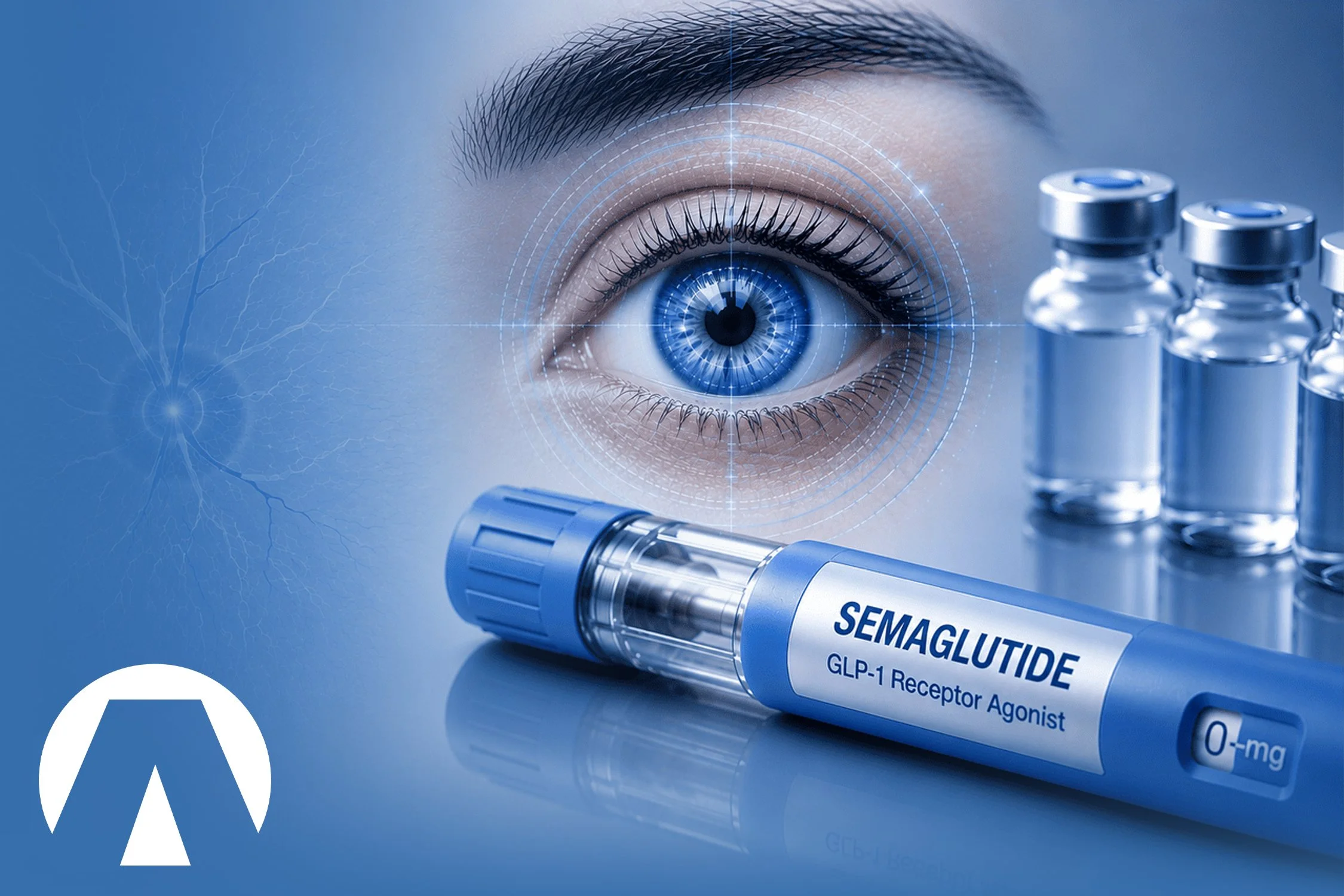
One area receiving increased attention is a possible association between semaglutide and non-arteritic anterior ischemic optic neuropathy (NAION), a rare but potentially serious eye condition that can cause sudden vision loss.
In 2025, European regulators concluded that NAION should be classified as a very rare side effect of semaglutide. At the same time, an important limitation needs to be understood: much of the large-scale evidence surrounding semaglutide and NAION comes from populations with type 2 diabetes.
For people without diabetes who use semaglutide specifically for weight management, the available evidence is more limited, and researchers are still working to determine the magnitude of any potential risk. (European Medicines Agency (EMA)
What Is NAION?
Non-arteritic anterior ischemic optic neuropathy is a condition involving reduced blood flow to the optic nerve, which carries visual information from the eye to the brain.
NAION typically causes sudden, painless vision loss in one eye. Vision loss can be significant and is generally irreversible. (World Health Organization)
NAION is not unique to people taking GLP-1 medications. Several health and anatomical factors can contribute to an individual's underlying risk.
The concern surrounding GLP-1 treatment is whether certain medications—particularly semaglutide—may increase that already low baseline risk in some patients.
Why Is Semaglutide Being Studied for NAION?
The issue gained widespread attention following a 2024 study published in JAMA Ophthalmology.
Researchers examined 16,827 patients evaluated at a neuro-ophthalmology service and compared patients prescribed semaglutide with patients receiving non-GLP-1 medications.
The researchers identified a higher risk of NAION among patients prescribed semaglutide in both the type 2 diabetes group and the overweight or obesity group. However, the study was retrospective and observational. It also involved a highly selected population treated at a neuro-ophthalmology practice rather than a representative general population. (JAMA Network)
This distinction is important.
An association means that two things occur together more frequently than expected. It does not necessarily prove that one directly caused the other.
This study is limited by referral bias (patients already referred for vision problems), small event counts, and a highly selected population. Population incidence of NAION is typically 2–10 per 100,000 person-years; the rates reported here are orders of magnitude higher and not replicated elsewhere.
What Has More Recent Research Found?
Subsequent studies have continued to investigate the potential association, with estimates of risk varying considerably.
A large 2025 JAMA Ophthalmology study analyzed data covering 37.1 million adults with type 2 diabetes across 14 databases. Researchers found a modest increase in the relative incidence of NAION associated with semaglutide exposure, but the estimated increase was substantially smaller than that reported in the original study. (JAMA Network)
Another study involving more than 3 million patients with diabetes found no statistically significant increase during the first year after semaglutide initiation but reported an increased risk at later follow-up intervals. The researchers again emphasized that additional investigation was necessary. (JAMA Network)
More recent research involving U.S. veterans with type 2 diabetes also identified an association. In that study, semaglutide initiation was associated with approximately twice the relative risk of NAION compared with initiation of an SGLT2 inhibitor. Importantly, the absolute cumulative risks remained low: 0.29% versus 0.13% over a median follow-up of 2.1 years. (JAMA Network)
These studies contribute to the safety signal surrounding semaglutide, but they also illustrate an important consideration for people using the medication solely for weight management: much of the largest observational evidence comes from patients who already have type 2 diabetes.
That matters because diabetes itself is associated with NAION risk.
What Have Regulators Said About Semaglutide and NAION?
In June 2025, the European Medicines Agency's Pharmacovigilance Risk Assessment Committee (PRAC) completed a review of the available evidence.
The review considered clinical trials, epidemiological studies, post-marketing safety information, nonclinical data, and published medical literature.
PRAC concluded that NAION is a very rare side effect of semaglutide, meaning it may affect up to 1 in 10,000 people taking semaglutide.
The agency also reported that several large epidemiological studies involving adults with type 2 diabetes suggested approximately a two-fold increase in the risk of developing NAION among people exposed to semaglutide compared with people who were not taking the medication. (European Medicines Agency (EMA)
The World Health Organization subsequently issued a medical product alert regarding the risk and the EMA's recommendation to update semaglutide product information. (World Health Organization)
Relative Risk vs. Absolute Risk
When discussing rare medication side effects, it is important to understand the difference between relative risk and absolute risk.
A study might report that a medication doubles the relative risk of an event. That can sound alarming, but the clinical significance depends heavily on how frequently the event occurs in the first place.
If an event is extremely uncommon, even a meaningful increase in relative risk may still represent a small absolute risk for an individual patient.
This distinction is particularly important with NAION because it remains an uncommon condition. The EMA classifies it as a very rare adverse effect of semaglutide, and large observational studies continue to report relatively low absolute event rates. (JAMA Network)
For patients considering semaglutide for medical weight management, both numbers need to be considered rather than interpreting relative-risk figures in isolation.
Why Is the Research Difficult to Interpret?
Many of the health characteristics associated with NAION also occur frequently among people who are prescribed semaglutide.
Potential or established risk factors for NAION include factors such as:
Older age
Type 2 diabetes
Hypertension
Obesity
Obstructive sleep apnea
Hyperlipidemia
Cardiovascular disease
This overlap creates an important challenge for observational research.
For example, someone prescribed semaglutide for diabetes or obesity may already have multiple conditions associated with NAION. Researchers can statistically adjust for known differences between patient groups, but observational studies cannot necessarily eliminate every source of confounding.
The original 2024 study attempted to account for several of these factors through propensity-score matching, including age, hypertension, diabetes, obstructive sleep apnea, obesity, hyperlipidemia, and coronary artery disease. Even so, the authors concluded that further research was necessary to assess causality. (JAMA Network)
What About Semaglutide for Weight Loss in People Without Diabetes?
This is particularly relevant for patients considering semaglutide specifically for medical weight management rather than diabetes treatment.
Much of the large-scale epidemiological evidence examining semaglutide and NAION has involved people with type 2 diabetes. Because diabetes itself is associated with NAION risk, findings from these populations cannot necessarily be applied directly to people without diabetes who use semaglutide for weight management.
The original 2024 JAMA Ophthalmology study reported an association among both patients with type 2 diabetes and patients who were overweight or had obesity. (JAMA Network)
At present, however, evidence specifically defining the absolute and relative risk among people without diabetes using semaglutide for weight management remains more limited.
It would therefore be premature to conclude either that people without diabetes face no increased risk or that their risk is identical to that observed in populations with type 2 diabetes.
Additional research is needed to determine whether particular cardiovascular, sleep-related, anatomical, or other health characteristics make certain weight-management patients more susceptible.
Does the NAION Risk Apply to Tirzepatide?
The regulatory conclusion discussed above is specifically about semaglutide.
Semaglutide is a GLP-1 receptor agonist, while tirzepatide acts on both GIP and GLP-1 receptors.
Although both medications may be used in medical weight-management settings, they should not automatically be assumed to have identical safety profiles.
This distinction is important when discussing potential side effects with patients.
What Symptoms Should Patients Watch For?
Patients taking semaglutide should seek medical attention if they experience sudden vision loss or rapidly worsening eyesight.
The EMA specifically advises patients experiencing these symptoms during semaglutide treatment to contact their healthcare professional without delay.
If NAION is confirmed, the EMA recommends that semaglutide treatment be stopped. (European Medicines Agency (EMA))
Sudden vision loss can have multiple causes, some of which require urgent treatment. Patients should not assume that an abrupt change in vision is simply a medication side effect or wait for the symptom to resolve on its own.
Should Weight-Management Patients Stop Taking Semaglutide Because of NAION Concerns?
Patients should not stop a prescribed medication solely because they have heard about a potential NAION association without first discussing their individual situation with their healthcare provider, unless they are experiencing an urgent medical problem requiring immediate evaluation.
For people using semaglutide as part of a medical weight-management program, treatment decisions should be individualized and may take into account factors such as:
Medical history
Diabetes status
Cardiovascular risk
Blood pressure
Sleep apnea history
Eye health
Other medications
Weight-management goals
Expected benefits of treatment
Individual risk factors
Semaglutide has established benefits for weight management and metabolic health, as well as cardiovascular benefits in appropriate patient populations. Those benefits need to be considered alongside potential adverse effects.
Putting the NAION Risk in Perspective
The potential relationship between semaglutide and NAION should be taken seriously because NAION can cause permanent vision loss.
At the same time, perspective matters.
European regulators classify NAION as a very rare side effect of semaglutide, potentially affecting up to 1 in 10,000 people taking the medication. Observational studies have identified an association, but estimates of its magnitude vary considerably. In addition, much of the strongest large-scale observational evidence comes from populations with type 2 diabetes. (JAMA Network)
For people without diabetes using semaglutide for weight management, the available evidence is less extensive, making it difficult to precisely quantify individual risk.
For patients considering or currently using semaglutide, the appropriate approach is not to ignore the potential risk or become unnecessarily alarmed by it. Instead, treatment decisions should be based on an individualized assessment of benefits, risks, medical history, and treatment goals.
At Affinity Whole Health, GLP-1 treatment for medical weight management is approached on an individualized basis, with consideration of a patient's health history, treatment goals, potential benefits, and relevant risk factors.
Patients using semaglutide who experience sudden vision loss or rapidly worsening eyesight should seek prompt medical attention and discuss appropriate next steps with their healthcare provider.
This content is for educational purposes only and does not constitute medical advice. Prescription treatment decisions should be made with a qualified healthcare provider based on an individual's medical history, risk factors, and clinical evaluation. Sudden vision loss or rapidly worsening eyesight requires prompt medical attention.
References
Hathaway JT, Shah MP, Hathaway DB, et al. Risk of Nonarteritic Anterior Ischemic Optic Neuropathy in Patients Prescribed Semaglutide.JAMA Ophthalmology. 2024;142(8):732–739. doi:10.1001/jamaophthalmol.2024.2296. (JAMA Network)
Cai CX, et al. Semaglutide and Nonarteritic Anterior Ischemic Optic Neuropathy.JAMA Ophthalmology. 2025. doi:10.1001/jamaophthalmol.2024.6555. (JAMA Network)
European Medicines Agency. PRAC concludes eye condition NAION is a very rare side effect of semaglutide medicines Ozempic, Rybelsus and Wegovy. June 2025. (European Medicines Agency (EMA))
World Health Organization. The use of semaglutide medicines and risk of non-arteritic anterior ischemic optic neuropathy (NAION). June 27, 2025. (World Health Organization)
New-Onset Nonarteritic Anterior Ischemic Optic Neuropathy and Initiators of Semaglutide in US Veterans With Type 2 Diabetes.JAMA Ophthalmology. (JAMA Network)
https://www.aaojournal.org/article/S0161-6420(24)00685-7/fulltext
https://www.sciencedirect.com/science/article/pii/S0002939425000947